
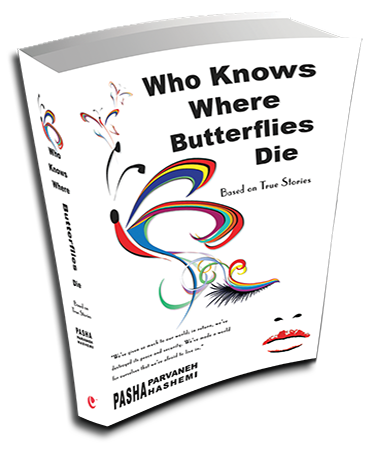
Book Excerpt: Who Knows Where Butterflies Die
(Navbars) برای خواندن به پارسی، از تکمه های جستجو استفاده کنید

Chapter 1
The Big Bang of Life
Since early morning, the kids had not been able to take their eyes off the big classic pendulum clock in the living room. It seemed like forever since their mother had gone to the hospital to give birth to their baby sister. And on that sunny spring day, they were told that their father was bringing them home. All three of them were glued to the window overlooking the street, anxiously counting down every minute to lay eyes on them. In the meantime, they bombarded their babysitter with hundreds of questions about babies.
Early afternoon, they saw their father’s car turning onto their street. They immediately yelled “They’re here!” to notify the babysitter while rushing to greet them. By the time they excitedly opened the door, their father had pulled up in front of the house. The kids had missed their mother so much and were happy to see her again. As they saw her walking into the house with the baby in her arms, supported by their father’s strong hold, they jumped up and down with joy.
It was a thrilling event for the entire family, especially for the children. They were so enthusiastically waiting to take their first peek at their baby sister that they could hardly restrain themselves. A few times, they had to be pulled away from their mother’s path by the babysitter to let her get to the baby’s room first. Even though she was quite weak and exhausted, she clearly appreciated her children’s excitement and curiosity. She kept sending them kisses in the air and waving at them with a big smile.
Finally, they made it up the stairs and into the beautifully decorated baby’s room. As soon as the mother placed the baby in her crib, it was time to show her off. All of them, even the babysitter, were stretching their necks to take a good look at the sleeping beauty. She was so tiny that she was almost lost within the folds of her soft pink blanket. She looked like a little princess as she lay safe and sound, surrounded by her family’s love. “Wow,” everyone said, admiring her beauty.
The baby’s siblings, a sister and two brothers, didn’t know what to think of her. At first, they’d thought she could play with them as soon as she was brought home. But seeing how tiny she was made it clear that they would have to wait for her to grow up a little before she could run around and play with them. The next thing they were all curious about was “what to call the baby.”
It was a beautiful, warm spring day. Nature had woken up and persuaded the earth to breathe, leaves to grow, and the flower-bearing plants to bloom. The playful birds were chirping and soaring in the sky. The air was fragrant and the streets colourful with fallen pink and white cherry blossoms. Most of all, butterflies were fluttering everywhere, complementing nature’s beauty. Since she was born right in the middle of it all, they thought of a name that would be a reminder of such a fabulous season: “Butterfly.” They all agreed that it was a most suitable name. Not only did it have the essence of the season, but it was also descriptive of such a stunning, delicate, tiny baby girl …
* * *
Butterfly and her family were living in their little corner in the capital city of Farawayland, minding their own lives. Her parents were educated, intelligent, and well-travelled individuals who had seen life both inside and outside of the bubble of their homeland. They were dedicated to the well-being and education of their children, not only in an academic but also in a social sense. They tried to teach them to be open-minded and respectful of everyone’s rights and boundaries. They wanted them to always live by high values and keep their integrity intact, for they believed that nothing was more important than one’s dignity.
The mother was a wonderful and kind-hearted petite woman with shoulder-length, wavy, dark blonde hair, fair skin, and light hazel eyes. Her soft voice and never-fading smile had made her one of the most popular personalities amongst their extended relatives and neighbours. She had a good sense of humour and laughed often. Her laughter was contagious, making everyone laugh along with her in no time. Her mind was always occupied with concerns about the well-being of her husband and children, and she did her best to keep them happy at all times. Her husband was so proud of her and thought of her as the light of their home. Whenever she was away, he would leave all the lights on to illuminate the house throughout her absence.
The father, a strong, tall, and successful well-known businessman, had the main priority of providing the best for his family. Along with his wife, he was running his own business and working hard to provide a safe, comfortable life for everyone at home. They both were loyal and respectful to each other, always supporting one another to make the pillars of their home as strong as they could possibly be. Family values were important to them, and for that reason, they were trying to be at their best at all times as role models for their children. They wanted them to have a good image of a strong and healthy family life so they could practice it in their own lives. The two were always so loving and caring towards each other that they became known as the “lovebirds.”
Their homeland, Farawayland, was home to many different cultures, dialogues, and ethnicities living together as a nation. To the north, it was as green as an emerald, surrounded by majestic, tall mountains, spotted with lakes like platinum plates. Long, wide rivers brought life-giving water to every corner of the land, and in some high elevations, they had created breathtaking waterfalls. The wet climate regularly washed the crisp, fresh, evergreen leaves and seasonal shrubs, making them shine even in a single ray of sunlight.
The northern people were mostly blond, with fair skin and light-coloured eyes. Going south, the land became drier until transformed into sculpted deserts. Most people in the rural areas were nomadic herdsmen and farmers, living in the remote highlands or migrating along with the changing weather, much as they had for thousands of years. Most of their economic lives were based on their farmlands and the sheep they raised. The long roads going through the mountains connecting Farawayland to the rest of the world brought together traders and merchants from all corners of the known world. The diversity of the climate, landscape, ethnicity, and means of livelihood created a multicultural kingdom unlike any other.
People from all regions of the great Farawayland were courageous and strong in body and spirit, but they were also kind and good-natured. They were patriotic and willing to defend their beloved homeland, with their lives if necessary.
The kingdom was enormous and rich, with natural resources underground and in its waters. These, combined with its vast cultural assets, were more than enough to provide for the people if managed intelligently and equitably. However, at one point in time, the kingdom was ruled by a fanatic tyrant who considered himself to be the absolute power in Farawayland. He called himself the Great Ruler. He neglected the poor and disadvantaged in favour of his wealthy friends and collaborators. He had inherited power from his father, who had taken power in a military coup, and his regime lacked legitimacy and widespread support. His efforts to modernise and westernise the country were most apparent in the urban centres and among the economic elite, and this intensified the many divisions between urban and rural, rich and poor, new and old.
Because of his cynical state of mind and alienation from his people, he had no strategy for good governance and instead relied on terror and oppression to suppress opposition. Instead of sharing the wealth of the land with his people, he kept them in constant poverty to make them feel dependent and occupied. They were so busy providing for their basic necessities that they had neither time nor resources to oppose his tyranny or organise to improve their condition.
Over time, the combination of the Great Ruler’s insecurity, obsession with power, and fear of losing it became so out of control that he created a circle of his own confidants, called “Vigilants,” to be his ears and eyes and protect him from his own people. Their job was to live among the commoners, spying on them to detect any plot they might have against the Great Ruler and his family. The much-feared secret law enforcers alienated the public, kept the opposition underground, and created a false impression of stability. The country was dangerously riven by factions and inherently unstable, ripe for change when the right conditions occurred.
The Vigilants were well taken care of by the monarch, and became so spoiled with their lavish lifestyles that they were anxious to keep them perpetually—at any price. They also knew that as long as the Great Ruler kept his throne, they could continue to have their lucrative positions and lavish lives. As a result, they became selfish, vicious tormenters without mercy, more than anyone could imagine. They were everywhere, disguised as ordinary citizens—dressed as friends, subordinates, or gardeners—and as they mingled in the texture of the society, they watched everyone like hawks.
The Vigilants created an intense fear over the entire empire, suppressing everyone to keep quiet, obey, and live as they enforced. Those who did not comply were sent to the Great Ruler’s awful jails, where they suffered until they died. The oppression was so great that hardly anybody dared to talk about the Great Ruler and anything related to him, his family, and his governing system in any place at any time. To protect their children in case of a trap, parents warned them to stay away from those who talked about him, his family, and his Vigilants; furthermore, they insisted that they never mention his name anywhere at all, not even to their closest friends.
Over time, such a strong empire turned into an invisible prison, confining millions of its hospitable, brave citizens. Hindered, this intelligent, sophisticated nation was desperately waiting for a sudden change while watching the rest of the world progress far ahead of them in many ways.
Nonetheless, even in such a prolonged, oppressive atmosphere, there were many courageous, bright freedom fighters who had no fear of speaking their minds. The regime broke their pens whenever they wrote about the ongoing ugly truth about the covered-up misdeeds of their governing system, but the freedom fighters continued to pick up their broken pens, and their writing became bolder and louder. Their goal was to inform the people of the tyranny and inefficiency of their ruler and his supporters for their time. They had no concerns of being captured by the Vigilants and kept in the Great Ruler’s horrifying dungeons. The dungeons were said to be the darkest places of all, smelling of rotten flesh and blood, and they were intentionally filled with flesh-eating rats in order to manage the bodily remains of horrendous, repeated torture. The freedom fighters believed their moral missions were greater than their lives, and by sacrificing themselves, they were hoping to restore their nation’s deserved freedom and dignity.
* * *
In such a despotic time, Butterfly was growing up amid generous love and care from her family members, relatives, and friends. She was too young to know what was happening in the real world. She was just enjoying being beautiful and the centre of her family’s attention, as well as being spoiled with attention from everyone in her world.
She was always dressed in fashionable clothing and groomed nicely for occasions. Her wavy dark blond hair was usually kept long. Her mother liked to comb it away from her face and secure it with decorative snaps. She wanted her daughter’s big, serene, hazel eyes, enhanced with long eyelashes, to shine through at all times. With her adventurous personality, Butterfly soon became an active participant in her siblings’ play, making their wishes come true much faster than they expected.
They lived in a nice, three-story old brick house in one of the greenest parts of the capital city. It was surrounded by established cherry and walnut trees. It was in the shade during long, hot summers and in the sunlight in cold winters. The master bedroom and a study for everyone to quietly read or think were located on the third floor. Four bedrooms were on the second floor, all of their entrances making way to a long, wide fenced hallway overlooking the living room below. The cherry-red wooden railing along the hallway continued on both sides of a spiral staircase down to the living room, right by the fireplace. A chandelier, hanging from the ceiling in the curve of the stairs, shone onto a big tropical plant beneath, adding glamour to the entire space. The living room area, which was connected to the dining room and the open kitchen, was spacious and could accommodate large groups of people for gatherings.
The entire house was lovely, comfortable, and well-maintained, but the most favourable part for all was the backyard. This was where everyone enjoyed making many fun memories, especially throughout the hot days. It had a big swimming pool, with a turquoise-coloured base, as the focal point of the garden, serving many different purposes. For one thing, it was important to the overall climate of the house in the heat of the long summers. It stretched north to south, almost the length of the backyard, in the usual direction of the wind. When the air passed over the water, it cooled down and moistened before drifting through the interior of the house, working like a natural air conditioner. For another thing, it was like heaven for the family and their visitors, particularly for children who could never get enough of playing in the water.
Large, rectangular gardens stretched alongside the length of the pool. There was always something blooming, no matter what time of the year it was. Especially in the summertime, they were often loaded with colourful pansies, lilies, cyclamens, assorted fuchsias, gladiolas, red azaleas, and many different shrubs bearing small flowers.
To the right of the house, facing south, there was a large honeysuckle vine. It was heavy with aromatic, white flowers twining over a tall wooden arch made by Butterfly’s father. It had grown so big that a large portion of it was overflowing to the other side of the wall, leading to the back alley. The kids made necklaces or bracelets with the flowers by passing a string through them to either wear or give to their friends and teachers as gifts. Past the honeysuckle vine were the twining grape vines, on a separate wooden arch bearing fruit. The juicy, large, green, seedless grapes grew through the mesh holes and hung from the arch in large bunches. They had to be shielded from the birds and bugs until they were ready to be picked. To protect them, Butterfly’s mother placed them one by one inside little sacks made of delicate, sheared, natural cotton while they were still growing on the stems.
To the left of the pool, in the other garden bed, there was another handmade, wooden arch. That was to support two bushy rose trees covered with big, velvety, pink and red scented flowers. Their fragrance, especially in the afternoon after water had been sprayed everywhere, was so fresh and therapeutic that if the family closed their eyes, they felt like they were in heaven.
At the far end of the garden grew a humongous, century-old mulberry tree. This tree was one of the most native trees in all of Farawayland. With its huge, rough trunk and long, bushy shade-bearing branches stretched to all sides, it had a majestic presence. Its leaves were dark green and shaped like wide ovals with pointed tips, and its fruit was light yellowish beige with long, round bodies made of tiny sacks filled with delicious light syrup when ripe. From dawn to dusk, all kinds of birds feasted on that fruit, more than any other ones in the garden. The tree itself had nests of many different birds and kept them sheltered from the scorching heat and predators. The ground underneath that tree was often covered with sticky, rotting berries that had to be washed away frequently to keep the bugs away.
Picking mulberries was a happy family time in Farawayland, especially at Butterfly’s house. When friends and relatives arrived at that function, they would usually start by chit-chatting over a cup of tea. Soon they would start shaking the mulberries from the tree while joking and laughing the entire time, concluding the evening with dinner and dancing, having fun until late at night.
To get ready for the arrival of the guests, Butterfly’s father would first clean the backyard with a long hose, spraying the plants all over to cool them down, which created a pleasant atmosphere scented with fruits and flowers.
On the other side of the yard, over a wide terrace, her mother would set the tables with a variety of home-made pastries, cakes, assorted nuts, and their garden’s fruits, also brewing the typical tea. The naturally scented, black tea was brewed in a special, tall gold-plated water boiler inherited from her mother. Water boilers came in different shapes and sizes; some were elaborately carved with such intricate designs that many people chose to use them just for decoration. The traditional ones used coal for heat, but the more modern ones were electric. They were made of three parts: a base to provide the heat, a large middle compartment to hold the water to boil with a tap at the front, and a flat top to use as a platform for the teapot to brew.
Getting the best colour and taste out of tea leaves when brewing tea was a traditional skill that one had to master to succeed. The tea was usually served in clear cups in order to see its colour, and was usually served with sugar cubes on the side. A perfectly brewed tea had a dark cherry colour, and its aroma would fill the air as it was being poured into cups. Some would drink it strong, and others would dilute it with some hot water from the water boiler’s tap, adjusting it to their liking.
When it came to picking the mulberries, a couple of adults would climb the tree to shake the juicy fruit from the branches. Others would hold a clean, wide sheet or fine mesh under the tree to catch the falling berries, which could be as large as two inches long. To avoid getting sticky, they tried to avoid the berries landing on their hair and clothes. However, those in the tree would still manage to catch some of the guests unguarded when a loaded branch was shaken, making everyone laugh. Typically, a few kilograms of berries were shaken off each time, and they were always shared generously with neighbours, including those who did not make it to the event.
Those days in particular were Butterfly’s favourite ones. For one thing, she loved having her friends and relatives around. And for another, it was the time she could show off her ability to climb the mulberry tree and wobble a few branches when no other kids could.
The Faces Behind the Masks
Regardless of what was going on within the boundaries of the people’s homes, life was no longer as wonderful as it should have been in Farawayland. The suffering from the oppression created by its dictatorial government was growing to an unbearable point. The authorities had already banned most of the existing books that had any notion of objection to their ruling system, with severe punishment if found in anybody’s possession. To brainwash the people, they had also republished schoolbooks to control what the youth were learning. On top of that, they had total control of the communication systems and media and what was being broadcast. They were quite afraid of the nation using the mass communication avenues to organise themselves against them.
The outrageous limitations to freedom of any kind made the majority of people, especially the youth and academic elite, feel frustrated, not to mention humiliated. Knowing the world was watching them suffer without doing anything significant about it, they were convinced that the timing was not quite right for its superpowers to intervene. The power bloc was probably benefiting from the situation so much that they did not care about the excruciating pain that the silent victims were enduring.
Butterfly’s father occasionally had the opportunity to get his hands on some of the authentic, banned books to keep for a short time before passing them on. He then shared their stories with his young family, keenly but tactfully, just to inform them of the world they were living in to prepare them for the worst.
The storytelling would usually start at dinnertime and continue in the living room, sometimes until late at night. During this time, they would reconnect as a family and get into the hearts and minds of each other by sharing memories and laughter. Most of all, they would demystify the ongoing social and global problems without having the fear of a Vigilant spying on them.
…
- To learn more about the book, please click here.
- To learn more about the author, please click here.
- To order the book, please click here.